
The Expense Has Been There So Long That Everyone Stopped Asking About It
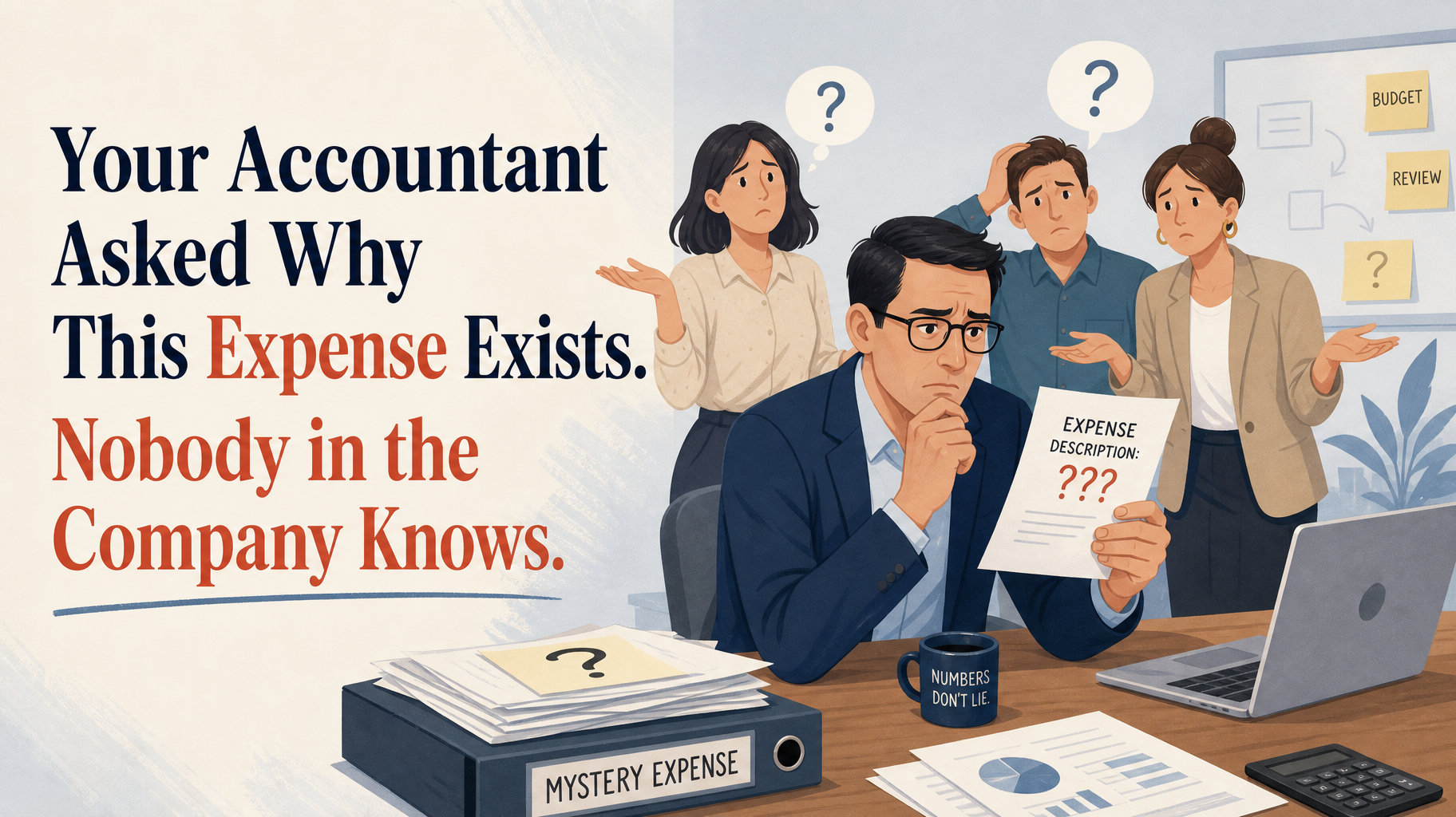
Every month, the company pays S$1,800 to the same supplier. The amount is not particularly large compared with payroll, rent or major supplier bills, so nobody pays much attention to it. Finance records the transaction under software or administrative expenses, the bank payment goes through automatically and management sees the amount buried somewhere inside the monthly accounts. Then one day, the accountant asks a very simple question: “What exactly is this S$1,800 for?” Finance checks the invoice and sees a vague description. Operations says they do not use the service. Sales thinks marketing might be responsible. Marketing says the subscription was probably started by someone who left the company two years ago. Management cannot remember approving it. Nobody is certain who owns the expense, whether the service is still active or whether the company is receiving any value from it. The business has been paying S$21,600 a year for something that has become so normal nobody remembers why it exists. This kind of situation is more common than many business owners realise. Companies spend enormous effort approving new expenditure but often pay much less attention to expenses that have been quietly recurring for years.
New Expenses Usually Receive More Attention Than Old Ones
When a company wants to buy something new, management often asks several questions. Why do we need it? How much does it cost? Which department will use it? Is there a cheaper alternative? Who approves the purchase? The first payment therefore receives scrutiny. After that, the expense gradually becomes part of normal operations. Month two arrives and nobody asks again. Month six arrives and it appears in the budget. By year two, employees may assume the expenditure must be necessary because the company has always paid it. The original decision slowly disappears from memory while the payment continues automatically. This creates an interesting weakness in many organisations. The company may have strong controls around starting an expense but almost no process for deciding whether that expense should continue.
Recurring Payments Are Convenient Precisely Because Nobody Needs to Think About Them
Automatic billing is excellent for efficiency. Software subscriptions, cloud services, telecommunications, maintenance contracts and many professional services can be charged automatically without someone processing an invoice manually every month. The business avoids missed payments and employees spend less time on administration. But the same convenience can make expenditure invisible. When nobody needs to actively approve the payment each month, nobody is forced to ask whether the company still needs the service. A subscription can therefore survive long after the original business problem disappeared. Convenience reduces administrative work, but it can also reduce attention.
S$1,800 a Month Does Not Feel Like S$21,600 a Year
Recurring costs often appear psychologically smaller because businesses see the monthly amount. S$100 per month feels inexpensive. That is S$1,200 a year. S$500 per month becomes S$6,000 a year. S$1,800 per month becomes S$21,600. A company with twenty different subscriptions can easily accumulate a six-figure annual technology and service bill without any individual decision ever feeling particularly large. Looking at annualised costs can therefore change how management evaluates recurring expenditure. The question stops being, “Would we pay S$1,800 this month?” and becomes, “Would we knowingly spend S$21,600 this year for this service?” Sometimes the answer remains yes. Sometimes management realises nobody would approve the expense today if it were presented as a new annual commitment.
The Problem Is Not That Recurring Expenses Are Bad
Businesses need recurring services. Accounting software, cybersecurity, payroll systems, cloud storage, telecommunications and many other subscriptions can provide substantial value. The objective should not be to cancel everything simply because the company wants to reduce costs. The more useful goal is to understand what the business is paying for and whether each material recurring expense still supports a genuine operational requirement. An expense can be completely worthwhile even if it has existed for ten years. The problem begins when management does not know enough to make that judgement.
A Forgotten Subscription Is Usually a Process Problem, Not Just a Waste Problem
If the company discovers one unused S$1,800 subscription, management may immediately cancel it and celebrate the saving. That solves the individual expense, but it may not solve the underlying weakness. How did the cost continue for years without ownership? Could another twenty expenses be in the same situation? Does the company know who is responsible for each recurring service? Is there a list of renewal dates? Does anyone review inactive user accounts? If the process remains unchanged, the business may simply create another forgotten subscription next year. Cost savings become more sustainable when management fixes the process that allowed unnecessary expenditure to survive.
The Employee Who Bought It May Have Left Years Ago
Many forgotten costs begin with staff turnover. An employee signs up for a service because the business genuinely needs it. The employee later resigns. Their replacement uses a different platform, but nobody cancels the old one. Finance sees the recurring invoice and assumes the department still needs it. The department assumes finance would cancel anything unnecessary. The supplier continues charging. Everyone behaves reasonably within their own responsibilities, yet the company keeps paying. This is why employee departures should trigger more than removing email access and collecting laptops. Businesses should also review subscriptions, vendor accounts and recurring commitments associated with departing employees.
Former Employees Can Leave Behind More Than Empty Desks
Software licences, mobile lines, cloud accounts and professional memberships can continue after employees leave if the company does not have a structured offboarding process. A former manager may still occupy a paid licence even though their login has not been used in months. A corporate phone line may continue being billed because nobody remembers it exists. A service subscribed by an old project team may remain active indefinitely. Individually, these amounts may be small. Across years and multiple employees, they can become significant. Employee offboarding should therefore include a financial review of recurring services connected to the employee, not merely an IT checklist.
The Company May Be Paying for Two Tools That Do the Same Thing
Digitalisation can create another form of recurring-cost duplication. The finance team uses one platform. Marketing purchases another tool that contains similar functionality. Management later adopts a larger enterprise system that already includes both features. Nobody cancels the earlier subscriptions because each department sees only its own budget. The company now pays three vendors for overlapping capabilities. This is increasingly common because software businesses continually add features that compete with other tools. A periodic review of the company’s software portfolio can therefore reveal duplication that was not obvious when the subscriptions were purchased separately.
Departments Often Optimise Their Own Budget Instead of the Company’s Total Cost
Imagine sales pays S$300 per month for one tool, marketing pays S$400 for another and operations pays S$250 for a third. Each department considers the cost reasonable. Collectively, however, the company may be spending S$950 every month on functions that could be handled by a single platform. Decentralised purchasing can help departments move quickly, but it also makes company-wide visibility more important. Finance may be the only team capable of seeing the complete pattern because every invoice eventually appears in the accounts.
This Is Where Good Bookkeeping Can Reveal a Business Problem
Bookkeeping is often treated as the process of recording what the company already decided to spend. In reality, organised financial records can also help management identify patterns worth questioning. If software expenses increased from S$4,000 a month to S$9,000 over two years, that trend deserves explanation. If professional fees continue appearing after a project ended, someone should investigate. If a supplier invoice repeats every month but nobody can identify the service, the transaction should not simply remain invisible because it was correctly entered into the accounting system. Good bookkeeping creates visibility, and visibility gives management an opportunity to ask better questions.
Recording an Expense Correctly Does Not Prove the Expense Is Necessary
This distinction is important. The accountant may have classified the S$1,800 payment perfectly. The invoice may be legitimate. The supplier may be genuine. The payment may be properly authorised under existing procedures. None of those facts answers whether the business still benefits from the service. Accounting records tell management what happened financially. Management still needs to decide whether the commercial decision remains sensible.
A Budget Can Accidentally Protect Unnecessary Spending
Budgets are useful for controlling expenditure, but they can create a strange effect when historical costs automatically become next year’s baseline. Last year’s budget included S$21,600 for a service, so finance carries S$21,600 into next year’s budget. Management focuses on the new expenses and significant increases while assuming the existing line item must be necessary. Over time, the budget becomes a record of historical habits rather than a fresh decision about future resource allocation. Periodically starting from the question “Would we approve this expense today?” can help challenge costs that remain only because they existed yesterday.
Zero-Based Thinking Does Not Mean Rebuilding the Entire Budget From Scratch Every Month
The phrase “zero-based budgeting” can sound extreme, but management does not need to justify every S$5 stationery purchase from first principles every year. A practical version is to review material recurring expenses periodically and ask whether the business would still choose them if the decision were being made today. This creates enough challenge to prevent unnecessary costs from becoming permanent without creating endless bureaucracy.
Annual Renewals Are Natural Review Points
Many subscriptions and service contracts renew annually. Businesses can use the renewal date as a built-in decision point. Thirty or sixty days before renewal, the department responsible for the service can confirm whether it is still required, how many users remain active, whether pricing changed and whether better alternatives exist. If nobody can provide a clear owner or business reason, the renewal should receive closer attention. The review does not need to be complicated. A short confirmation can prevent another year of unnecessary spending.
Auto-Renewal Can Turn Inaction Into a Financial Decision
Automatic renewal is convenient for suppliers because the contract continues unless the customer cancels. From the company’s perspective, this means doing nothing is effectively a purchasing decision. The business commits to another year simply because nobody remembered the deadline. Management should therefore understand significant renewal terms and notice periods. Missing a cancellation window can lock the company into expenditure it no longer wants.
The Contract May Be More Expensive to Exit Than Management Expects
Some services cannot simply be cancelled tomorrow. Contracts may contain minimum terms, early termination charges or notice periods. This is another reason businesses should review recurring costs before they become urgent. Discovering that a service is unused is frustrating. Discovering the company must continue paying for another nine months because the cancellation period passed is worse. Maintaining basic contract information such as renewal dates and notice requirements can prevent unnecessary expenditure.
Usage Data Can Answer Questions Memory Cannot
For software and digital services, management may be able to see how many employees actively use the system. Suppose the company pays for 50 licences but only 18 users logged in during the last three months. That does not automatically mean 32 licences can be cancelled, because some employees may use the service infrequently but importantly. However, the data gives management a reason to investigate. Usage statistics provide a more objective basis for decisions than simply asking, “Does anyone still use this?”
An Unused Licence Is Easy to Find, but an Underused Service Is Harder
Sometimes every employee technically uses the system, but nobody uses the features that justify the premium subscription. The company may pay for an advanced tier while staff use only basic functionality available on a cheaper plan. Management should therefore evaluate not only whether the service is used but whether the company is using what it pays for. Downgrading can sometimes produce savings without changing employee workflows at all.
Cheap Monthly Services Can Be More Difficult to Challenge Than Large Purchases
A S$100,000 equipment purchase usually requires quotations, management approval and careful analysis. A S$99 monthly subscription might be purchased instantly on a corporate card. Yet if dozens of employees can make similar purchases independently, the total cost can eventually exceed the equipment purchase. Businesses should therefore design purchasing controls based not only on individual transaction size but also on recurring commitments. A small monthly expense has a different financial character from a one-time S$99 purchase because it may continue indefinitely.
Corporate Cards Can Make Subscription Growth Harder to See
Corporate cards make online purchases convenient, but they can also fragment recurring costs across employees and departments. One employee subscribes to an analytics tool, another to a design platform and another to a database. Finance sees the transactions but may not know which department owns them. Clear card descriptions, supporting documents and expense categories can help the company understand what recurring charges represent rather than allowing them to disappear among hundreds of card transactions.
“Software Expense” Can Become Too Broad to Be Useful
If every digital service goes into one large general ledger account, management may know that software costs S$120,000 annually without knowing what the company actually purchased. Breaking information into useful categories or maintaining supporting schedules can make analysis easier. The accounting structure should not become excessively complicated, but it should contain enough detail to help answer relevant management questions. Financial reporting is most useful when it explains the business rather than merely balancing mathematically.
The Same Problem Can Happen With Professional Services
Forgotten recurring expenses are not limited to software. A company may continue paying a monthly advisory fee after the original project changed. It may maintain multiple service retainers because nobody reviewed overlapping scopes. A consultancy arrangement may have started during a period of rapid growth and continued even after an internal employee took over much of the work. Again, the expense may still provide value. The point is that recurring professional fees deserve periodic review just like technology subscriptions.
Insurance, Maintenance and Memberships Can Also Become Invisible
Insurance policies, equipment maintenance plans, industry memberships, data subscriptions and various corporate services can renew annually with minimal management attention. Some are essential. Others may become unnecessary after the business changes. A company might still insure equipment it sold, maintain a membership employees no longer use or pay for maintenance on a system scheduled for replacement. Regular review helps ensure historical commitments still reflect current operations.
Business Changes Faster Than Contracts Do
Companies change constantly. Employees leave, offices move, customer segments change and technology evolves. Contracts do not automatically adapt. The subscription bought for a 10-person company may become unnecessary when the business grows to 50 employees and adopts a different system. A service required during expansion may become redundant once internal capability improves. Periodic expense review is therefore not only about cutting costs. It is about aligning expenditure with the business the company has become rather than the company it used to be.
Acquisitions Can Create Massive Duplication
If one company acquires another, both businesses may bring their own accounting systems, CRM tools, software subscriptions, insurance arrangements and professional service providers. Unless someone reviews these costs collectively, the combined company can spend heavily on duplicate services. Integration planning should therefore include vendor and subscription rationalisation, not only organisational charts and customer operations.
Rapid Growth Can Hide Waste Because Revenue Is Increasing Faster
Waste becomes easier to tolerate when the company is growing quickly. Revenue increases by S$2 million and management pays little attention to an extra S$20,000 of subscriptions. During slower periods, those costs suddenly become visible. The better approach is not to wait for financial pressure before reviewing recurring expenses. A disciplined company can remain cost-aware even while business is strong.
Cost Discipline Is Different From Cost Cutting
There is an important distinction between eliminating waste and cutting resources indiscriminately. A company should not cancel a useful cybersecurity service simply because the annual fee looks high. Nor should it remove accounting software that saves employees hundreds of hours. Cost discipline means knowing what the business spends, understanding why and ensuring the value remains reasonable. Cost cutting focuses primarily on reducing the number. The first approach is usually healthier because it protects valuable capability while identifying genuinely unnecessary expenditure.
The Cheapest Supplier Is Not Automatically the Best Outcome
When management discovers an expensive service, the reaction may be to replace it with the cheapest alternative available. But price alone does not capture reliability, support, integration costs or employee productivity. A S$500 monthly platform that saves 50 employee hours can be more economical than a S$100 platform that creates manual work. Reviewing expenses should therefore focus on total value, not simply identifying the lowest price.
Ask What Would Break if We Cancelled It Tomorrow
This is one of the most useful tests for a questionable recurring expense. Suppose management cancels the service tonight. What happens tomorrow? Which employees cannot work? Which customer process fails? What information disappears? Which legal or compliance requirement becomes a problem? If nobody can identify any meaningful impact, that is a strong signal the expense deserves further review. If several critical processes immediately fail, management has discovered why the service exists.
Then Ask Who Owns the Service
Every material recurring expense should ideally have an owner inside the business. This does not mean the person pays the bill personally. It means someone understands why the company uses the service and can confirm whether it remains necessary. Finance can identify the cost, but the relevant department may be better positioned to assess operational value. Clear ownership prevents the familiar situation where finance asks operations, operations asks marketing and everyone eventually says, “Maybe management knows.”
Expense Ownership Should Survive Employee Turnover
If the service owner resigns, responsibility should be reassigned rather than disappearing. A simple vendor or subscription register can show the service, cost, department, owner, renewal date and perhaps basic contract information. This does not need to become a complicated procurement system. Even a well-maintained list can dramatically improve visibility for smaller businesses.
Finance Can Become the Early Warning System
Because finance sees recurring transactions across the entire organisation, it can identify patterns no individual department notices. A monthly charge continues after an employee leaves. A supplier invoices two departments for similar services. Software costs increase faster than headcount. A contract renews at a significantly higher price. Finance should be empowered to ask questions rather than simply process payments. This transforms bookkeeping information into a management tool.
But Finance Cannot Know What Every Expense Is For
A bank transaction or invoice description rarely explains the complete business purpose. Finance may see S$5,000 paid to a technology vendor but not know whether the tool supports cybersecurity, customer service or marketing. Departments still need to provide context. A strong process combines financial visibility with operational ownership rather than expecting accountants to independently determine whether every service is commercially useful.
Management Should Review Trends, Not Just Individual Invoices
A single S$500 invoice may not attract attention, but a trend can reveal something important. Software expenses rose 40 per cent. Professional fees doubled. Telecommunications costs increased despite fewer employees. Subscriptions grew every quarter. Monthly management accounts become more useful when they highlight changes rather than simply presenting totals. Management can then investigate whether the increase represents productive investment or uncontrolled cost accumulation.
Percentage Growth Can Make Small Categories Worth Investigating
Suppose annual software expenditure rises from S$50,000 to S$85,000. The absolute increase is S$35,000, which may not appear huge in a multimillion-dollar business. But the 70 per cent growth should still have an explanation. Perhaps the company intentionally invested in new systems. Great. Perhaps half of it represents redundant subscriptions. Management will not know unless someone asks.
Budget Variances Should Lead to Questions, Not Automatic Criticism
If a department exceeds its software budget by 30 per cent, management should investigate before assuming poor discipline. The department may have adopted a tool that significantly improved productivity. Conversely, a department can remain exactly within budget while wasting money on services nobody needs simply because those costs were already included. Budgets are useful signals, but they do not replace judgement.
A Recurring Expense Review Can Be Done Quarterly
Companies do not need to examine every subscription every week. A quarterly review may be enough for many SMEs. Finance can produce a list of significant recurring payments and ask departments to confirm ownership and continued need. Annual contracts can receive deeper review before renewal. High-growth categories can receive more frequent attention. The process should be proportionate to company size and expenditure.
Do Not Waste More Employee Time Reviewing Costs Than the Costs Are Worth
Cost control itself has a cost. Paying three managers to spend an hour debating whether to cancel a S$10 monthly subscription makes little economic sense. The review process should focus on material or recurring items where potential savings justify the effort. Automated reports and sensible thresholds can help management direct attention efficiently.
Large Savings Often Come From Many Small Decisions
A company may search for one S$100,000 cost reduction while ignoring 50 subscriptions that collectively cost the same amount. Small recurring savings compound. Cancelling an unnecessary S$500 monthly service saves S$6,000 each year. Remove five similar costs and the annual saving becomes S$30,000. If the cancellation has no negative operational impact, that saving falls directly to the company’s financial performance.
Every Dollar of Cost Saving Does Not Equal a Dollar of Revenue
This is another useful way to think about unnecessary expenditure. If a business has a 10 per cent net margin, generating an additional S$10,000 of profit through sales might require S$100,000 of extra revenue. Eliminating a genuinely unnecessary S$10,000 cost can have a much more direct effect on profit, although tax and other factors still matter. This does not mean companies should focus on cutting costs instead of growing revenue. It illustrates why waste deserves attention even in successful businesses.
Savings Become More Valuable When They Do Not Reduce Capacity
The best cost reductions are often invisible operationally. Cancelling unused licences, duplicate software or obsolete services can improve profit without asking employees to work harder or customers to accept worse service. This is very different from cutting experienced staff or essential systems. Management should prioritise waste before capability.
The Accountant’s Question May Be More Valuable Than the Answer
When your accountant asks, “What is this expense for?” it can feel annoying. Management wants accounts completed, not another email asking about a S$300 payment. But sometimes that question exposes a bigger weakness. Nobody knows what the payment is for. Nobody owns the service. Nobody reviewed it for years. The transaction has become a signal that financial information is disconnected from operational knowledge. Resolving that disconnect can improve far more than one expense line.
Good Bookkeeping Should Make Management Curious
At Bookkeeping Services Singapore, organised financial records can support businesses in understanding where money is going, how expenses are changing and which balances require attention. The value of bookkeeping is not simply knowing that the company spent S$1,800. It is creating enough visibility for management to ask whether the S$1,800 still makes sense. Accounts should not only record business decisions after they happen. They should help management make better decisions going forward.
Do Not Ask Finance to Cancel Something Before Finding Out What It Does
The opposite mistake is reacting too aggressively. Management sees an unfamiliar expense and immediately tells finance to stop payment. A week later, employees discover it was a critical cloud backup service or a system required for customer operations. Investigation should come before cancellation. Identify the service, owner, contract and impact. Then make an informed decision.
The Supplier May Be Able to Explain What Your Company Forgot
If nobody internally recognises a recurring invoice, the supplier may be able to provide contract details, account information or the original service scope. This can help management reconstruct why the relationship began. However, the fact that a supplier confirms the service exists does not automatically mean the company should continue using it. The question remains whether the service still creates value today.
Ask When the Service Was Last Used
Usage can be revealing. Perhaps the software was last accessed fourteen months ago. Maybe the consultancy delivered its final report last year but the retainer continued. Perhaps a membership has not been used since the employee responsible left. Evidence of inactivity provides a strong basis for deciding whether an expense remains necessary.
Ask What Would Replace It
Before cancelling something, understand whether employees will immediately substitute another cost. A team may stop using a paid platform and move to a different paid service. Perhaps the replacement requires more manual work. Savings should be evaluated net of replacement costs and productivity effects. A S$10,000 cancellation is not really a S$10,000 saving if it creates S$8,000 of additional labour or other expenditure.
Create a Simple Recurring Expense Register
For many SMEs, the solution can be remarkably simple. Maintain a list showing vendor, service, monthly or annual cost, responsible department, service owner, renewal date and cancellation notice where relevant. Review significant items periodically. When employees leave, reassign ownership. When new services are purchased, add them to the list. This small amount of administration can save substantial confusion later.
Link New Purchases to an Owner From the Beginning
Instead of asking who owns a subscription two years later, assign ownership when the service is purchased. Finance knows who to contact when invoices change, renewal approaches or usage needs clarification. The owner knows they are responsible for periodically confirming continued need. This makes recurring expenditure easier to manage throughout its life cycle.
Make Cancellation Part of the Procurement Process
When approving a new recurring service, management can ask how it would eventually be cancelled. Is there a 30-day notice period? Annual commitment? Auto-renewal? Early termination charge? This information may seem irrelevant during purchase but becomes extremely useful later. Every subscription has a beginning. Businesses should also know how it ends.
Sometimes the Expense Is Completely Worth It
After investigating the mysterious S$1,800 payment, management may discover that the service prevents thousands of dollars of manual work, supports an important customer or provides essential regulatory functionality. Excellent. The review has still created value because the company now knows why the expense exists and can continue paying with confidence. Cost review should not be judged only by how much money is cancelled. Understanding and validating important expenditure is also a successful outcome.
Conclusion: The Most Dangerous Expense May Be the One Nobody Notices Anymore
Your accountant asks:
“What is this S$1,800 expense?”
Finance does not know.
Operations does not know.
Sales does not know.
Marketing does not know.
Management vaguely remembers someone discussing it years ago.
And yet the company has paid it every month without interruption.
That is the real problem.
Not the S$1,800.
The problem is that the company is spending money nobody currently owns, understands or reviews.
Maybe the service is useless.
Cancel it.
Maybe it duplicates another tool.
Consolidate them.
Maybe half the licences are inactive.
Reduce them.
Maybe an employee who left three years ago subscribed to it.
Clean it up.
Maybe the contract automatically renewed because nobody noticed the deadline.
Track the next renewal.
Or perhaps the service is extremely valuable and the company simply forgot how important it was.
Keep it.
The point is not that every recurring expense should be cut.
The point is that management should know why the company is paying it.
Businesses usually become very disciplined when approving a large new purchase.
They compare quotations.
They negotiate.
They ask departments to justify the cost.
They seek management approval.
Then the payment becomes recurring and gradually disappears from attention.
Years later, nobody remembers the original decision, but the bank continues making it every month.
That is how small costs become permanent costs.
Good financial management is therefore not only about controlling what the company starts spending.
It is also about deciding what the company should stop spending.
Review recurring expenses.
Identify owners.
Check usage.
Understand renewal terms.
Remove duplicates.
Challenge unexplained increases.
And pay attention when the accountant asks a question that seems ridiculously basic:
“What is this expense actually for?”
If nobody knows the answer, do not tell finance to just use the same account code as last month.
Find out.
Because sometimes the most valuable thing inside your monthly accounts is not the number.
It is the question the number forces management to ask.