
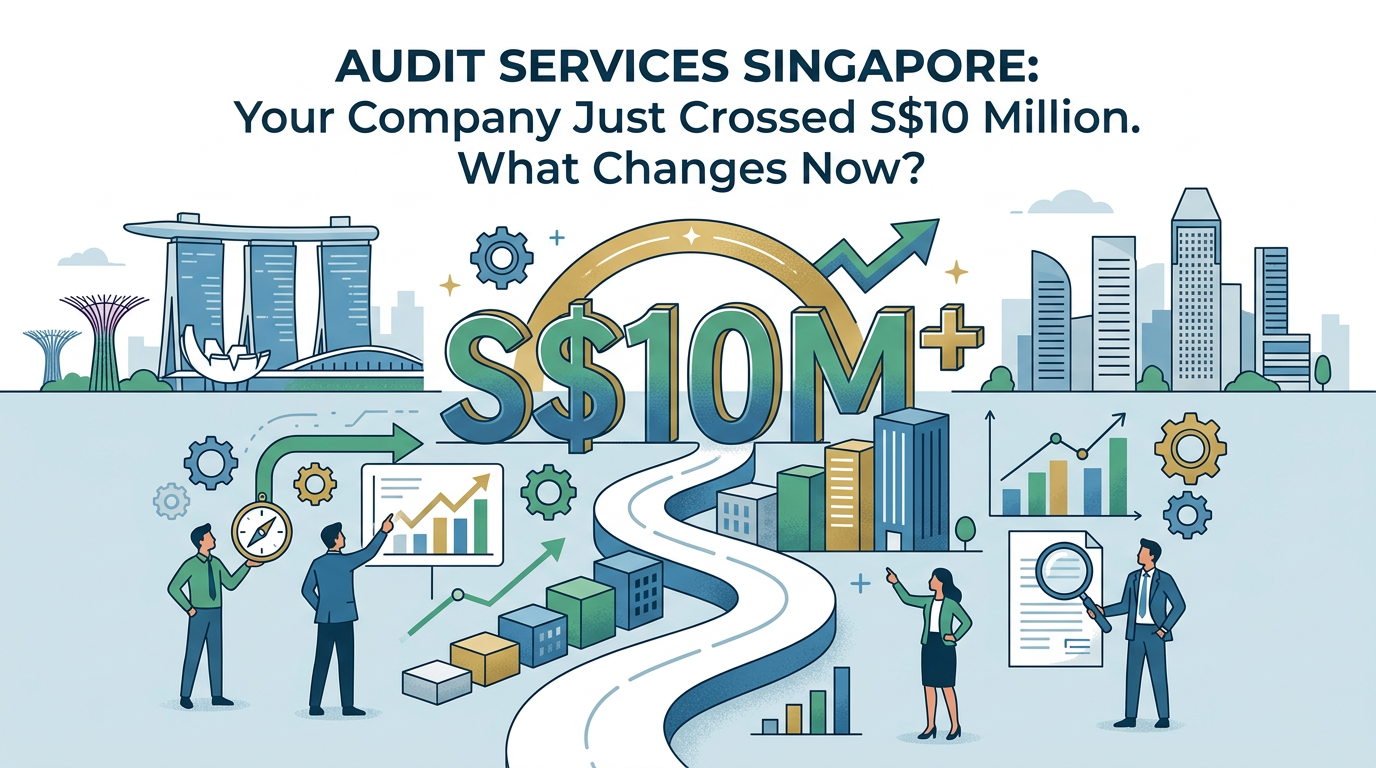
Crossing S$10 Million Feels Like a Milestone, Until Someone Mentions Compliance
Your company has finally crossed S$10 million in annual revenue. For many Singapore business owners, that number represents years of work, customer acquisition, hiring, investment and probably more than a few stressful months wondering whether the business would reach its targets. Revenue may have grown from S$3 million to S$5 million, then S$8 million, before finally passing S$10 million. Management celebrates, employees are proud and everyone begins discussing the next stage of growth. Then someone from finance asks a less exciting question: “Does crossing S$10 million mean we need an audit now?” Suddenly, what looked like a simple revenue milestone becomes a conversation about Singapore’s small-company audit exemption, assets, employee numbers, financial years and group structures. The good news is that crossing S$10 million in revenue does not automatically mean a company immediately becomes subject to statutory audit. The rules involve more than one number, which is why businesses looking for audit services Singapore should understand how the small-company criteria actually work before assuming that S$10,000,001 of revenue instantly changes everything.
S$10 Million Is Important, but It Is Not a Single Automatic Trigger
Under Singapore’s existing small-company audit exemption framework, a private company generally qualifies as a small company for a financial year if it is a private company throughout the financial year and satisfies at least two out of three quantitative criteria for each of the two immediately preceding financial years. Those criteria are total annual revenue of not more than S$10 million, total assets of not more than S$10 million and no more than 50 employees. This is an important distinction because business owners sometimes hear “S$10 million audit threshold” and understandably interpret it as a simple revenue test. In reality, revenue is only one of three criteria, and the assessment looks at the company’s circumstances across the relevant preceding financial years. A business should therefore not conclude that it has immediately lost its audit exemption simply because annual revenue moves from S$9.9 million to S$10.1 million.
Think of It as a Two-Out-of-Three Test
The easiest way for management to understand the framework is to stop thinking about one threshold and start thinking about three questions. Is annual revenue S$10 million or less? Are total assets S$10 million or less? Does the company have 50 employees or fewer? Under the current framework, meeting at least two of these quantitative criteria for each of the two immediately preceding financial years is central to determining small-company status, alongside the requirement to be a private company throughout the financial year. This means a company could exceed the revenue threshold while remaining within the asset and employee thresholds. Its position therefore needs to be assessed using the complete criteria rather than revenue alone. Conversely, a company that remains below S$10 million in revenue should not automatically assume it qualifies if it exceeds other relevant thresholds.
Imagine Revenue Reaches S$10.8 Million but Everything Else Remains Relatively Small
Consider a hypothetical Singapore private company that has experienced a particularly strong year. Annual revenue increases from S$8.7 million to S$10.8 million. The company has S$6 million of total assets and employs 38 people. Management sees revenue above S$10 million and assumes statutory audit must immediately apply. However, the company is still within the current quantitative limits for total assets and employee numbers. Since the framework operates using a two-out-of-three test over the relevant preceding financial years, management needs to assess the company’s complete circumstances rather than treating the revenue figure as a standalone switch. This is where getting appropriate advice can prevent unnecessary confusion. Companies considering audit services Singapore should have their actual eligibility assessed rather than relying on a headline threshold they encountered online.
The Two-Year Element Matters Too
Another detail that can surprise growing business owners is that the small-company criteria refer to the two immediately preceding financial years. This prevents the framework from being determined entirely by a single unusual year. A business might experience a temporary revenue surge because of one major project, while another may cross a threshold as part of sustained expansion. The rules need to be applied according to the relevant financial years and circumstances rather than management simply looking at this year’s management accounts and deciding whether an audit is required. This also means fast-growing companies should monitor their position in advance. If revenue, assets and headcount are all moving towards the existing thresholds, waiting until year end to think about audit requirements can leave the finance team scrambling to prepare.
Revenue Is Only One Sign That Your Company Has Become More Complex
Even where crossing S$10 million does not immediately change the company’s audit requirement, the milestone can still tell management something important. The business may simply be becoming more complex. A company generating S$2 million in revenue may process a few hundred transactions each month. At S$10 million, it may have substantially more customers, suppliers, employees, purchase orders, invoices and payment approvals. The business might also have expanded overseas, taken additional financing, purchased more assets or introduced new revenue streams. None of these developments automatically means the accounting function is inadequate, but they increase the amount of information that needs to be recorded and controlled. The finance processes that comfortably supported the company five years ago may no longer be appropriate for the organisation it has become.
Your Finance Team May Not Have Grown as Fast as Revenue
This is one of the most common growing pains experienced by SMEs. Revenue triples, customer numbers double and headcount expands, but finance remains almost unchanged. The same employee who handled bookkeeping when revenue was S$3 million is now responsible for a S$10 million business. That person may manage invoicing, customer collections, supplier payments, payroll coordination, GST matters, reconciliations, month-end closing and audit requests. The issue is not necessarily employee capability. There may simply be too much activity for the original structure. Growth often exposes weaknesses that were previously hidden because transaction volumes were smaller. Management should therefore consider whether responsibilities, systems and review processes have developed alongside the business rather than assuming a larger revenue number can be supported indefinitely by the same financial infrastructure.
The Owner Cannot Personally Check Everything Forever
When a company is small, founder involvement can be an extremely effective control. The owner may know every major customer, recognise every supplier and personally approve significant payments. At S$10 million of annual revenue, this approach can become increasingly difficult. There may be hundreds of payments, multiple department managers and thousands of transactions. If everything still requires the founder’s approval, the control can gradually turn into a bottleneck. The business may need clearer approval limits, delegated authority and appropriate segregation of responsibilities. Growing does not mean the founder needs to surrender financial oversight. It means oversight needs to become systematic rather than depending entirely on one person’s ability to remember everything.
More Revenue Usually Means More Receivables
A growing business can report impressive revenue while simultaneously creating pressure on cash flow. Suppose the company grows from S$8 million to S$11 million primarily because it wins several large corporate customers. Those customers may require 30-day, 60-day or longer payment terms. Revenue appears in the accounts, but the cash may arrive much later. Accounts receivable can therefore increase significantly as the business grows. Management needs reliable ageing information, collection procedures and credit controls. An S$11 million company with S$3 million of outstanding receivables faces a very different financial risk from an S$11 million company whose customers pay immediately. Revenue tells only part of the story.
More Revenue Can Also Mean More Supplier Exposure
Growth affects the other side of the balance sheet too. The company may purchase more inventory, use more subcontractors or order larger quantities from suppliers. Trade payables increase, purchase commitments grow and supplier relationships become more financially significant. Management needs to know not only what customers owe the company but also what the company owes others. A business can be profitable and still encounter cash-flow pressure when customers take 60 days to pay while suppliers expect payment within 30 days. As companies become larger, working capital management often becomes just as important as the profit shown in the income statement.
Assets Can Quietly Approach S$10 Million Too
Business owners naturally pay close attention to revenue because sales growth is visible and celebrated. Total assets may receive less attention even though they are another component of the current small-company criteria. A growing company may purchase equipment, build inventory, accumulate receivables or hold larger cash balances. Total assets can therefore increase alongside revenue. Management that monitors only annual sales could miss the fact that another relevant threshold is also being approached. Businesses near the existing small-company limits should therefore review revenue, total assets and employee numbers together rather than focusing on whichever figure receives the most attention internally.
Employee Numbers Matter Even When Employees Do Not Affect Revenue Directly
The third quantitative criterion concerns the number of employees. A company might remain below S$10 million in revenue while expanding its workforce beyond 50 people, or it might cross S$10 million while continuing to operate with a relatively lean team. Different industries scale differently. A technology or professional services business may generate substantial revenue with comparatively few employees, while a labour-intensive company may employ more people at a lower revenue level. This is precisely why the exemption framework uses multiple criteria. Company size cannot always be captured accurately by revenue alone.
Group Companies Need Additional Attention
The position can become more complicated when a company is part of a group. A company that is part of a group generally needs to consider not only whether it qualifies as a small company individually but also whether the group qualifies as a small group based on the relevant consolidated criteria. This matters for entrepreneurs who operate several entities and assume each company’s eligibility can always be considered independently. Corporate structures often become more complicated as businesses grow, particularly when owners establish separate entities for different operations, investments or markets. Businesses with group structures should therefore obtain advice based on the complete structure rather than applying the small-company thresholds to one entity in isolation.
ACRA Is Reviewing the Audit Exemption Framework in 2026
There is another reason the S$10 million conversation is particularly timely. In February 2026, ACRA announced a review of Singapore’s small-company audit exemption framework. Among the areas under review is whether the current S$10 million annual revenue and S$10 million total-assets thresholds should be increased. ACRA has also been considering whether certain subsidiaries could qualify for audit exemption even where the group itself does not satisfy the existing consolidated thresholds. The review is intended to examine whether compliance costs can be reduced for smaller businesses while maintaining appropriate safeguards. For business owners, the important point is that the existing framework should be followed unless and until changes take effect. A proposal or consultation should not be treated as though the law has already changed.
Do Not Make Compliance Decisions Based on Headlines About Proposed Changes
Whenever regulatory changes are discussed publicly, headlines can create confusion. An owner may read that Singapore is considering raising the audit exemption threshold and conclude that the company’s upcoming audit is no longer necessary. That would be premature. Businesses should distinguish between existing requirements and proposals under review. Until revised requirements take effect, companies need to assess their obligations using the rules that currently apply to them. This is particularly important for businesses close to the thresholds because assumptions can affect budgeting, audit appointments and year-end preparation. Companies searching for audit services Singapore should verify their position using current requirements rather than relying on social-media summaries or outdated articles.
Audit Exemption Does Not Mean Accounting Exemption
This is one of the most important points for growing businesses. Even if a company qualifies for audit exemption, it does not mean management can stop maintaining proper financial records. ACRA has emphasised that audit-exempt companies remain responsible for keeping proper accounting records and preparing financial statements in accordance with prescribed accounting standards. The annual audit is one part of the broader financial reporting environment, not a substitute for bookkeeping and accounting. A business that becomes audit exempt still needs reliable information to understand profitability, cash flow, receivables, liabilities and tax obligations.
Your S$10 Million Business Needs Better Accounts Even If It Does Not Need an Audit
There is a strange situation that can occur when companies focus too heavily on statutory requirements. Management asks, “Do we legally need an audit?” and if the answer is no, the conversation ends. But a company generating more than S$10 million in revenue may have shareholders, lenders, directors and managers relying on its financial information. The business may have millions of dollars in receivables and payables. Management may be deciding whether to hire, expand, borrow or enter another market. Reliable accounting becomes more important as these decisions become larger. The absence of a statutory audit requirement does not reduce management’s need to understand what is happening financially.
Your Bank May Care Even If the Law Does Not Require an Audit
Statutory requirements are not the only reason companies obtain audited financial statements. Banks and other lenders may request financial information as part of financing arrangements, depending on the facility and circumstances. A company might qualify for statutory audit exemption but still encounter contractual or commercial requirements relating to financial statements. This is why businesses should not automatically cancel an audit immediately after concluding that statutory exemption applies. Management should first review financing agreements and discuss requirements with relevant stakeholders.
Shareholders Can Have Their Own Expectations
Shareholders may also value independent assurance over financial information, particularly where ownership and management are separated. ACRA notes that shareholders holding at least 5% of a company’s total issued shares can require an audit even where the company otherwise qualifies for the small-company audit exemption. This illustrates an important distinction between statutory exemption and stakeholder needs. A company may not automatically be required to undergo an audit under the small-company framework, yet circumstances can still create a need for one. Management should therefore consider ownership arrangements rather than viewing audit exemption solely as an accounting department matter.
Investors May Ask Different Questions From Existing Owners
A business approaching S$10 million or S$20 million in revenue may also begin attracting investors or considering strategic partnerships. Potential investors generally want reliable financial information before committing capital. They may examine historical profitability, customer concentration, working capital, debt, liabilities and cash generation. The company’s financial records therefore need to withstand more scrutiny than they did when only the founder looked at the monthly bank balance. Even where an audit is not legally required, stronger financial discipline can make future due diligence considerably less painful.
Selling the Company Changes the Value of Historical Records
A founder may have no intention of selling today, but circumstances can change. If a potential buyer appears three years from now, they are unlikely to care that the company did not expect to be sold when earlier records were prepared. They may want several years of reliable financial information. Weak historical bookkeeping cannot always be repaired easily after the fact because employees leave, documents disappear and memories fade. Growing businesses should therefore consider financial records as part of the company’s long-term infrastructure. Good records are useful not only for compliance but also for financing, investment and eventual exit opportunities.
Crossing S$10 Million Can Expose Old Accounting Habits
A business that began with spreadsheets and informal processes may continue using them because they have always worked. The company may have one employee who understands every reconciliation and another who knows how a complicated spreadsheet operates. At S$2 million of revenue, these arrangements may be manageable. At S$10 million, the consequences of an error become larger. A formula mistake affecting 1% of S$100,000 is very different from a mistake affecting 1% of S$10 million. Growth magnifies both opportunities and weaknesses. Management should therefore periodically review whether systems remain suitable rather than waiting for an audit or financial problem to expose limitations.
Old Balances Become Harder to Explain With Time
Growing companies often accumulate mysterious balance-sheet items. There may be an “other receivable” that has existed for several years, a supplier credit nobody understands or a deposit relating to an old office. Employees see the balance every month but assume it must be correct because it was already there when they joined. Eventually an auditor or new finance manager asks what the amount represents, and nobody can provide an answer. The lesson is simple: age does not make an accounting balance correct. Regular reconciliations and review are important because unresolved items become more difficult to investigate as time passes.
Audit Preparation Should Begin Before the Auditor Sends the First Request
If a growing company expects that statutory audit may become relevant, waiting until the audit begins is inefficient. The finance team should already maintain reconciled bank accounts, supporting documents, customer and supplier schedules, fixed asset records and explanations for significant balances as part of normal accounting. Audit preparation should ideally be an extension of good year-round financial management rather than a separate emergency project. Businesses looking for audit services Singapore can make the engagement substantially smoother when their underlying accounting records are organised before fieldwork starts.
Do Not Hire More Finance Staff Before Understanding the Bottleneck
Crossing S$10 million can create pressure on the finance team, but the solution is not always to hire another employee immediately. Management should first identify where time is being consumed. Perhaps employees spend hours manually entering supplier invoices. Maybe customer information is transferred between several systems. Perhaps every payment requires too many approvals. Technology, integration or redesigned workflows may solve part of the workload without increasing headcount. Conversely, if important responsibilities are concentrated in one overwhelmed employee, additional resources may genuinely be necessary. The objective is to build an appropriate finance function rather than simply adding people whenever transaction volumes increase.
Technology Can Help, but It Does Not Replace Financial Controls
Accounting platforms, automation and AI can make financial processes significantly faster. Bank transactions can be imported automatically, invoice information can be extracted digitally and routine reports can be generated quickly. However, automation does not eliminate the need for review. If an automated rule is configured incorrectly, it may repeat the same error hundreds of times. Management needs appropriate controls around supplier creation, payment approvals, bank detail changes and accounting adjustments. The larger the business becomes, the more important it is to understand not only whether technology is being used but also whether employees know how to review what the technology produces.
Revenue Growth Can Hide Margin Problems
Crossing S$10 million is exciting, but management should ask how much profit was required to produce that revenue. A company can grow from S$8 million to S$11 million while becoming less profitable if costs increase faster than sales. Discounts may have been offered to win large customers. Additional employees may have been hired. Supplier prices may have increased. Marketing expenditure may have risen sharply. Revenue therefore needs to be considered alongside gross margins, operating costs and cash flow. Reliable financial reporting allows management to distinguish healthy growth from growth that simply makes the organisation busier.
Cash Flow Can Become More Difficult as the Company Gets Bigger
It sounds counterintuitive, but growth can create cash pressure. The company may need to purchase inventory before customers pay, hire employees before new projects generate cash or provide longer credit terms to larger clients. A business can therefore cross S$10 million in revenue while simultaneously feeling that there is less cash available. Management should monitor working capital carefully and forecast cash requirements rather than assuming higher revenue automatically produces greater liquidity. This becomes especially important when the company has tax obligations, loan repayments or major investments planned.
Management Reporting Needs to Mature Too
At an earlier stage, the owner may have managed the company primarily by looking at sales and the bank balance. As the business grows, those two numbers become less informative. Management may need monthly information about margins, customer concentration, overdue receivables, department costs and cash-flow forecasts. This does not mean creating hundreds of dashboards. It means identifying the information needed to make decisions. A S$10 million business should not discover three months later that a major customer stopped paying or that one product line has been losing money for half a year.
Audit Is Not a Punishment for Growing Successfully
Some owners view statutory audit as another compliance burden that appears once the company becomes successful enough. A more useful perspective is to recognise that larger businesses generally involve more stakeholders, larger transaction values and greater financial complexity. An audit provides independent assurance over the financial statements in accordance with applicable professional standards. It does not guarantee that every transaction is correct or that fraud can never occur, but it provides a structured independent examination of the financial statements. Companies using audit services Singapore should therefore approach the process as part of the financial governance of a growing organisation rather than simply another annual form to complete.
Choosing an Auditor Should Not Begin the Week You Need One
If a company’s growth trajectory suggests that an audit may become necessary, management should understand the requirements early and consider auditor appointment and preparation in good time. Leaving everything until the last minute can create pressure for both management and the finance team. Historical documents may need to be retrieved, accounting issues resolved and schedules prepared. Earlier planning allows questions to be addressed before deadlines become urgent. It also gives management time to understand what information the auditor will require and assign responsibilities internally.
Do Not Assume the Cheapest Audit Creates the Lowest Cost
Professional fees matter, particularly to SMEs, but the audit fee is only one part of the cost. Employees also spend time preparing schedules, retrieving evidence, answering questions and resolving accounting issues. A poorly organised engagement can consume significant management time even if the quoted fee is low. When comparing providers of audit services Singapore, businesses should therefore consider experience, communication, planning and ability to handle the company’s circumstances alongside price. The objective is not simply to buy an audit report as cheaply as possible. It is to complete the required professional process efficiently and appropriately.
Your Business May Be Bigger Than Its Processes Realise
Perhaps the most important consequence of crossing S$10 million has nothing to do with a specific statutory threshold. The milestone can serve as a signal that management should examine whether the company’s internal processes still match its scale. Does one person still control too many financial functions? Does the owner approve everything? Are customer collections properly monitored? Are supplier bank detail changes independently verified? Can management obtain reliable monthly financial information? Are supporting documents easy to retrieve? Could another employee perform the finance manager’s responsibilities if that person suddenly resigned? These questions become increasingly important as the value and volume of transactions grow.
Conclusion: S$10 Million Is a Reason to Review, Not a Reason to Panic
Crossing S$10 million in annual revenue is an achievement. It should not immediately turn into panic about audit requirements. Under Singapore’s current small-company framework, the position is more nuanced than a single revenue threshold. The quantitative test considers revenue, total assets and employee numbers, with at least two of the three criteria needing to be satisfied for each of the two immediately preceding financial years, alongside other relevant conditions. Companies that are part of groups also need to consider the applicable group requirements.
At the same time, 2026 is an interesting year because ACRA is reviewing the audit exemption framework, including whether the existing S$10 million revenue and total-assets thresholds should be increased. Businesses should follow any eventual changes, but proposed reforms should not be mistaken for rules that have already taken effect.
The bigger lesson is that crossing S$10 million should encourage management to look beyond the threshold itself.
Revenue has grown.
Have the finance processes grown?
Customer numbers have increased.
Have receivables controls improved?
More employees are making decisions.
Have approval responsibilities become clearer?
Transaction volumes have increased.
Are reconciliations and supporting records keeping up?
The company may still qualify for audit exemption.
It may become subject to statutory audit later.
Stakeholders may request audited information even where statutory exemption applies.
Whatever the answer, the company still needs reliable financial records.
For businesses evaluating audit services Singapore, the sensible starting point is therefore to determine the company’s actual position based on the applicable requirements and circumstances rather than assuming that crossing one headline number automatically decides everything.
At Bookkeeping Services Singapore, businesses can seek professional support for their accounting and financial reporting requirements as their operations become more complex. Maintaining organised and reliable accounting records throughout the year can also make any future audit process considerably more manageable.
So when your finance team walks into the meeting and says:
“Boss, we crossed S$10 million. Do we need an audit now?”
There is no need to cancel the celebration.
Just do not answer the question by looking at revenue alone.