
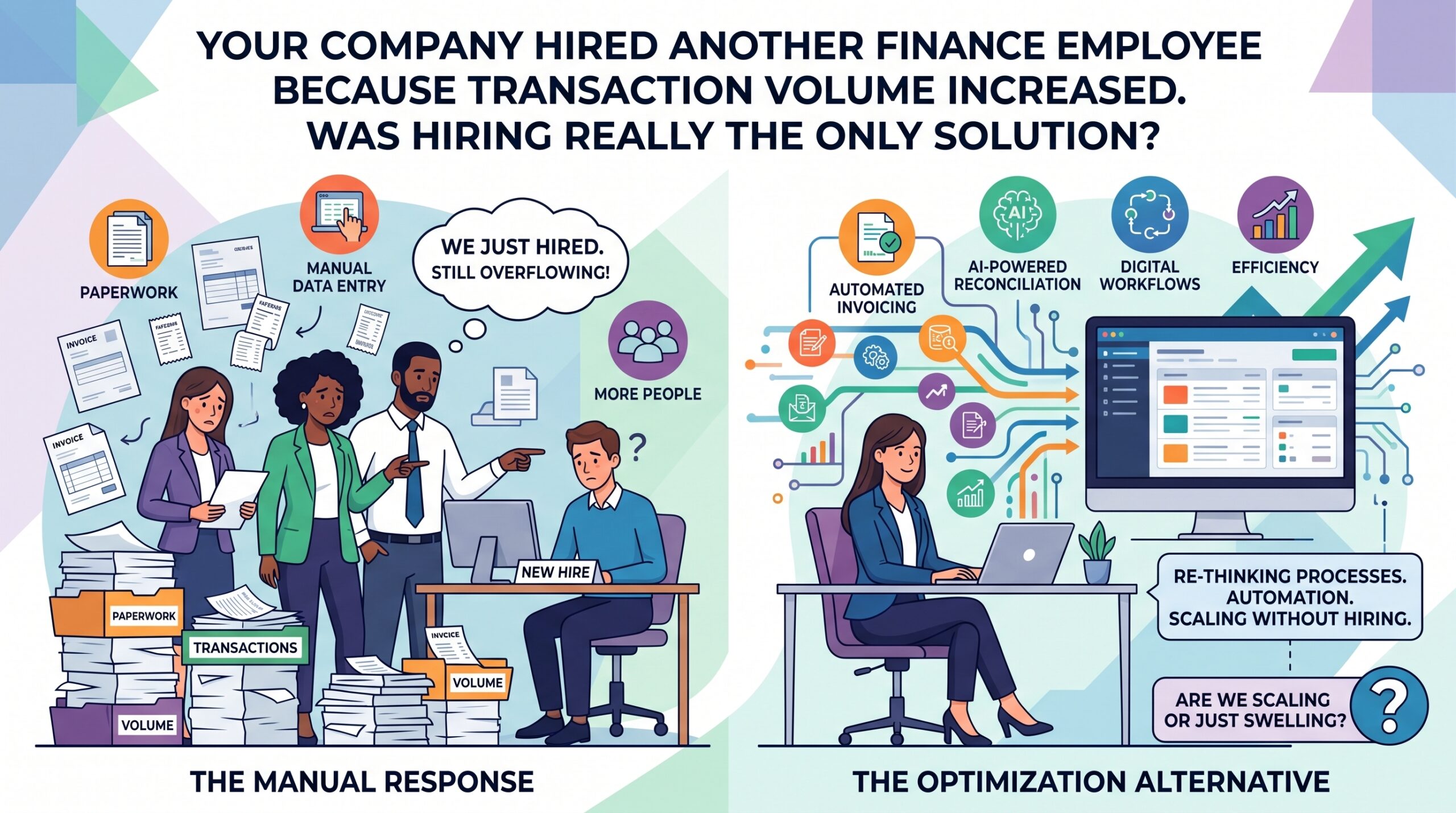
Growth Creates More Work, but More Work Does Not Always Require More People
A growing business eventually reaches a familiar point. Revenue has increased, the number of customers has doubled, suppliers are sending more invoices, employees are submitting more claims and the finance team seems permanently busy. Someone says the obvious solution is to hire another finance employee. If the existing team processes 1,000 transactions a month and the company now expects 1,500, adding another person appears logical. Sometimes it is exactly the right decision. However, businesses should first ask a more important question: why does every additional transaction require so much additional human effort? If employees are manually downloading invoices, entering the same information into multiple systems, matching payments one by one, chasing approvals through email and rebuilding reports in spreadsheets every month, increasing headcount may simply add more people to an inefficient process. Growth should certainly increase some workload, but transaction volume and finance headcount do not necessarily need to rise at the same rate.
The Finance Team May Be Busy Because the Business Became Bigger
Not every workload problem indicates inefficiency. A company processing 5,000 invoices will naturally have more work than a company processing 500. More customers can mean more invoices, receipts, credit notes and collection activities. More suppliers create additional purchase invoices and payments. More employees create payroll records, reimbursements and administrative transactions. Expansion into additional locations or business entities can introduce reconciliations, intercompany transactions and reporting requirements. Finance therefore needs sufficient capacity to support the scale and complexity of the organisation. The mistake is not hiring people when they are genuinely needed. The mistake is assuming that transaction growth automatically proves another employee is necessary without first examining how the work is performed. A business that understands the source of its finance workload can distinguish between work that genuinely requires additional capacity and work that exists because the process has not evolved with the company.
The First Question Should Be Where the Finance Team’s Time Actually Goes
Before approving another position, management can learn a great deal by looking at how the existing team spends a normal week or month. Perhaps employees spend substantial time entering supplier invoices. Another large portion of the month may disappear into bank reconciliation, customer collection, expense claims, payroll preparation or management reporting. There may also be less visible work such as searching for missing documents, correcting coding errors, following up on incomplete information and answering questions that could have been prevented earlier in the process. Once management understands where the hours go, the hiring discussion becomes much more useful. If the team genuinely has more high-value accounting work than existing employees can reasonably handle, additional headcount may be justified. If a significant amount of time is being consumed by repetitive administrative work and preventable corrections, however, the company may have opportunities to redesign the process before permanently increasing payroll.
One Invoice Can Create Far More Work Than Management Realises
Consider what happens when a supplier sends an invoice. In a well-designed process, the document might enter the accounting workflow electronically, be associated with the appropriate supplier and purchase information, go through the required approval and ultimately become available for payment and reconciliation. In a highly manual environment, the same invoice might arrive in one employee’s email, be downloaded, renamed and saved into a folder. Someone then enters the supplier, amount, invoice number and expense category into the accounting system. A copy is emailed to a department manager for approval. The manager replies several days later. Finance updates a spreadsheet showing that approval was received, schedules the payment, later downloads a bank statement and manually matches the payment back to the invoice. None of these individual steps sounds enormous, but repeated across thousands of transactions, small inefficiencies can consume hundreds of working hours.
Hiring Can Hide a Process That No Longer Scales
Imagine a finance team of three people struggling with 3,000 monthly transactions. Management hires a fourth employee and the immediate pressure decreases. A year later, transaction volume reaches 4,000 and the department is overloaded again. Management hires a fifth person. At 5,000 transactions, the same discussion returns. If every 1,000 additional transactions require another employee, the company should ask whether this relationship is inevitable or merely the result of its current operating model. A process that worked perfectly when the business was small may become expensive when multiplied thousands of times. Hiring can temporarily relieve the symptoms while leaving the underlying design unchanged. This is particularly important for growing SMEs because administrative headcount can increase gradually without management noticing how much of the company’s cost structure is being built around repetitive processes.
Calculate the Cost of the Process, Not Just the Employee’s Salary
When businesses compare hiring with process improvement, they should consider the full economic cost rather than simply comparing a software subscription with a monthly salary. An employee’s cost includes more than basic salary. Depending on the circumstances, the company may also incur employer contributions, bonuses, leave, insurance, equipment, software licences, recruitment expenses, training and management time. There is also the cost of replacing employees who leave after becoming familiar with the company’s processes. At the same time, automation and system improvements are not free. They can involve implementation fees, subscriptions, configuration, integration, training and ongoing maintenance. The objective is therefore not to prove that technology is always cheaper than people. Management should compare the realistic cost and benefit of different approaches and determine which combination provides sufficient capacity, reliability and flexibility as the business grows.
Repeated Data Entry Is One of the First Places to Look
One of the clearest warning signs is information being entered manually more than once. A sales system contains the customer order, but finance manually re-enters the information to create an invoice. A supplier invoice already contains the amount, date and invoice number, yet an employee types every field into the accounting software. Payroll information is prepared in one spreadsheet and copied into another system. Bank transactions are downloaded and manually recreated somewhere else. Every repeated entry consumes time and creates another opportunity for mistakes. As transaction volume increases, the cost multiplies. A process requiring only two minutes of unnecessary data entry may seem trivial, but across 5,000 transactions it represents more than 160 hours of work. Businesses often look for dramatic efficiency projects while overlooking thousands of tiny repetitive tasks that collectively create the need for additional capacity.
Manual Reconciliation Can Become a Major Monthly Workload
Bank reconciliation is an essential financial process, but the amount of human effort required can vary dramatically depending on how transactions are recorded and matched. If customer references are inconsistent, payments are received without clear identifiers or accounting records are incomplete, employees may spend hours determining which payment belongs to which invoice. Supplier payments can create similar problems. As transaction volume increases, unresolved differences accumulate and month-end becomes increasingly stressful. Better processes, cleaner transaction references and appropriate accounting technology can reduce some of this effort, although human review remains important for unusual items and genuine discrepancies. The goal should not be to eliminate reconciliation. It should be to avoid spending skilled finance employees’ time manually solving routine matches that could have been structured more effectively from the beginning.
Approval Processes Can Quietly Become Finance Problems
Finance teams are often blamed for slow payments even when finance is not causing the delay. An invoice arrives but requires approval from a department manager. Finance sends an email. Nothing happens. Three days later, another email is sent. The supplier begins asking about payment. Finance follows up again. Eventually the manager approves the invoice, but by then an employee has spent significant time simply chasing someone else’s decision. Multiply this across hundreds of invoices and the finance department becomes an internal reminder service. Hiring another finance employee may help send more reminders, but it does not solve the approval bottleneck. Businesses should examine whether approval responsibilities are clear, whether managers receive timely notifications, whether escalation rules exist and whether the process gives finance visibility without requiring employees to manually chase every outstanding item.
Errors Create Work That Transaction Counts Do Not Show
Two companies may each process 5,000 transactions a month while requiring very different levels of finance staffing. In one company, most transactions arrive with correct information, appropriate supporting documents and clear approvals. In another, invoices contain incorrect purchase information, expense claims are incomplete, customer records are duplicated and managers frequently request corrections after transactions have been entered. The second finance team is not merely processing 5,000 transactions. It may effectively be processing many of them twice. Error rates therefore matter when assessing workload. Management should look at how much time employees spend correcting information and why those errors occur. If the same problem happens every month, repeatedly correcting it is not an efficient long-term solution. The source of the error may sit in sales, procurement, operations or the system itself rather than inside finance.
Month-End Pressure Often Reveals Weaknesses From the Entire Month
Businesses sometimes believe they have a month-end closing problem when they actually have a month-long information problem. Finance spends the final days chasing missing invoices, identifying expenses that were never submitted, reconciling transactions that were incorrectly recorded and asking departments to explain payments made weeks earlier. Management then concludes that the finance team needs another employee because closing takes too long. Additional capacity might help, but the underlying question is why so much information remains unresolved until month-end. If transactions are captured accurately and supporting documents are collected throughout the month, closing should become more predictable. A strong finance process distributes work across the reporting period rather than allowing unresolved issues to accumulate into a large administrative exercise at the end.
Spreadsheets Are Useful Until They Become Invisible Infrastructure
Excel remains one of the most useful tools in business, and there is nothing inherently wrong with finance teams using spreadsheets. Problems emerge when the organisation depends on a growing network of manual spreadsheets that duplicate information already stored elsewhere. One employee exports an accounting report, cleans it in Excel and sends it to another employee, who copies selected numbers into a management reporting workbook. Someone else maintains a separate payment tracker because the accounting system is not configured to provide the required view. Over time, these spreadsheets can become essential to the company’s operations without management understanding how they work. If the person who built the workbook takes leave or resigns, the process may suddenly become difficult to operate. Before hiring another employee to maintain additional spreadsheets, management should ask whether the information flow itself can be simplified.
Automation Should Remove Repetition, Not Remove Judgement
The alternative to hiring is not necessarily replacing finance employees with machines. Modern finance operations contain many tasks that benefit from automation and many that still require human judgement. Repetitive data capture, standard matching, routine reminders and recurring report preparation may be suitable for greater automation. Deciding how to account for an unusual transaction, reviewing unexpected variances, assessing the reasonableness of information and advising management require a different type of involvement. The best objective is often to move employees away from repetitive administration so they have more capacity for work that requires understanding and judgement. A company may still need to hire as it grows, but the new employee can then support higher-value activities rather than spending most of the day copying information between systems.
Artificial Intelligence Does Not Automatically Fix an Inefficient Finance Process
The current excitement around AI creates another temptation. Instead of hiring another employee, management may decide to buy an AI tool and assume the workload problem is solved. That can be equally misguided. If supplier information is inconsistent, approvals are unclear and documents arrive through five different channels, adding AI on top of the process may simply create another layer of technology. Businesses should first understand what causes the workload and then determine which tools are appropriate. AI may help with document extraction, classification, analysis or other activities depending on the solution, but technology delivers better results when the underlying process is reasonably structured. Automating confusion does not necessarily create efficiency. Sometimes it simply allows confusion to move faster.
Outsourcing Can Be Another Form of Capacity
Hiring and automation are not the only choices available. Some businesses may determine that certain accounting and bookkeeping activities can be outsourced rather than supported entirely through permanent internal headcount. This can be particularly useful when workload fluctuates, the company needs access to accounting expertise without building a large department or routine bookkeeping is consuming time that internal employees could spend supporting management. Outsourcing is not appropriate for every activity, and businesses still need internal ownership of their financial information. However, it changes the capacity discussion from a simple choice between “hire someone” and “make the existing team work harder”. The more useful question is which activities should remain internal, which can be automated and which can be supported externally.
Do Not Outsource a Bad Process and Expect It to Become Good
Outsourcing should not become another way of avoiding process improvement. If documents arrive late, approvals are unclear and departments provide incomplete information, an external bookkeeping provider will still need to deal with those problems. The administrative burden may simply move from an employee to a service provider. Businesses considering outsourcing should therefore examine how information will flow between the company and the provider, who is responsible for approvals, when documents must be submitted and how exceptions will be resolved. Clear responsibilities can make outsourcing efficient. Unclear responsibilities create endless follow-ups regardless of whether the person sending the email sits inside or outside the company.
Standardisation Becomes More Valuable as Transaction Volume Grows
When a business processes 50 transactions a month, employees can remember unusual arrangements and manually handle exceptions. At 5,000 transactions, that approach becomes difficult. Growing companies benefit from standardising common processes such as supplier onboarding, invoice submission, expense claims, payment approvals and customer creation. Standardisation reduces the number of decisions employees must repeatedly make and makes automation easier because transactions follow more predictable paths. It also makes training new employees simpler. This does not mean every transaction must be forced into an inflexible process. Genuine exceptions will always exist. The objective is to make the normal 80% or 90% of transactions easy to process so employees can concentrate on the smaller number that genuinely require attention.
Supplier Onboarding Can Prevent Problems Before the First Invoice Arrives
Many accounts payable problems begin before finance receives an invoice. Supplier names may be inconsistent, payment terms may not be recorded, bank details may arrive through informal channels and departments may engage suppliers without following a standard onboarding process. Finance then spends time resolving these issues when payment becomes urgent. A structured supplier setup process can reduce later administrative work by ensuring that essential information is captured once and maintained properly. This is an example of improving the upstream process rather than adding people downstream. The finance team cannot efficiently process information that arrives incomplete, and increasing headcount does not change that basic reality.
Customer Setup Can Reduce Work on the Receivables Side Too
The same principle applies to customers. Incorrect billing addresses, inconsistent company names, unclear payment terms and missing purchase order requirements can create repeated invoicing and collection problems. Finance may issue an invoice only to discover that the customer requires a particular reference or submission portal. The invoice is rejected, corrected and resubmitted, while payment is delayed. Management sees the finance team spending more time on receivables and assumes another employee is required. Yet some of the workload could potentially be prevented through better customer onboarding. Collecting the correct billing information before the first invoice is issued reduces rework and can also improve cash collection.
Measure Transactions Per Employee, but Do Not Stop There
Management can use productivity measures to understand whether finance capacity is changing, but simple transaction counts should be interpreted carefully. Transactions per finance employee can provide a useful trend, especially if the company compares its own performance over time. However, not all transactions require equal effort. One straightforward recurring supplier invoice is different from a complex foreign-currency transaction requiring investigation. A company that expands internationally may require more finance capacity even if transaction volume remains similar because complexity has increased. Management should therefore combine volume measures with indicators such as processing time, error rates, outstanding reconciliations, days required to close the month and the proportion of work requiring manual intervention.
Track How Much Work Is Rework
One particularly useful measure is the amount of finance time spent correcting something that should have been right the first time. How many supplier invoices require clarification? How many customer invoices are reissued? How many expense claims are returned because information is missing? How many transactions need manual correction during reconciliation? How many month-end adjustments arise because something was coded incorrectly earlier? Rework is expensive because the company pays once to perform the task and again to correct it. If transaction volume rises by 20% but rework rises by 50%, the real problem may not be growth. Understanding this distinction can change the decision from “hire another person” to “fix the process generating the errors”.
Ask Whether Finance Is Doing Work That Belongs Somewhere Else
As businesses grow, finance departments sometimes accumulate responsibilities simply because they are organised and reliable. Finance starts maintaining operational spreadsheets, chasing purchase approvals, correcting customer information, administering systems and answering questions that should be handled elsewhere. Eventually management concludes that finance is understaffed. Before adding another employee, it is worth reviewing whether every activity genuinely belongs in finance. Returning responsibility to the appropriate department can reduce workload while improving accountability. Sales should provide accurate customer information. Department managers should approve their expenses promptly. Employees should submit complete claims. Procurement should maintain appropriate supplier processes. Finance can support these activities, but it should not automatically become responsible for fixing every administrative weakness across the organisation.
Hiring May Still Be the Right Answer
Process improvement should not become an excuse for understaffing. There is a point where a growing business genuinely needs additional finance professionals. If transaction volume and complexity have increased substantially, existing employees are working reasonable processes efficiently and important work is still being delayed, hiring may be necessary. Additional capacity can improve segregation of duties, provide stronger review, support faster reporting and allow the department to perform analysis that was previously neglected. The objective is not to avoid hiring at all costs. It is to make sure the company hires because it needs additional capability rather than because inefficient processes have consumed all existing capacity. A well-designed finance function may eventually have more employees than before, but those employees should be doing work that creates value appropriate to their skills.
Sometimes You Need Both Better Systems and Another Employee
Business decisions do not need to fit into an artificial choice between people and technology. A company might automate invoice capture and bank matching while simultaneously hiring a finance manager who can improve forecasting and management reporting. Another business may outsource routine bookkeeping while retaining an internal employee who understands operations and works closely with management. A rapidly expanding group may need new systems, standardised processes and additional accounting staff at the same time. Growth changes the scale and complexity of finance, so the right solution is often a combination. What matters is that each additional cost solves the correct problem.
A Small Pilot Can Be Better Than a Large Transformation
Businesses do not need to redesign the entire finance function at once. If invoice processing is consuming the most time, start there. Document the current steps, estimate the hours involved, identify repeated manual activities and test whether one improvement reduces workload. If reconciliation is the problem, focus on transaction references, bank feeds, matching rules and the causes of recurring differences. If reporting takes five days every month, identify why employees repeatedly manipulate data manually. Small improvements can produce measurable results and reveal whether a larger investment is justified. This approach also makes it easier to compare process improvement with the cost of hiring because management can see whether the change actually releases meaningful employee capacity.
Use the Time Saved for Better Finance Work
Efficiency has limited value if the company saves 40 hours a month but nobody knows what to do with those hours. Management should decide where finance capacity can create greater value. Employees could spend more time reviewing overdue receivables, analysing margins, preparing cash-flow forecasts, investigating unusual expenses, improving budgets or giving managers better information. This is the difference between reducing administrative work and merely making employees less busy. The objective of a more efficient finance function should be to improve the quality and timeliness of financial management, not simply to process the same transactions faster.
Better Bookkeeping Can Support a More Scalable Finance Function
For businesses working with Yisong Accounting Management, bookkeeping support can form part of a wider decision about how the finance function should scale. Accurate transaction recording, accounts payable and receivable tracking, bank reconciliation and financial reporting all require capacity, but that capacity does not always have to come from continuously increasing permanent internal headcount. A growing company can consider how internal employees, accounting systems, automation and outsourced support work together. The appropriate structure will differ between businesses, but the objective remains the same: financial information should remain accurate and timely even as transaction volume increases, without allowing administrative complexity to grow faster than the company itself.
The Best Time to Review the Process Is Before the Team Becomes Overwhelmed
Companies often wait until employees are working late, month-end reports are delayed and suppliers are complaining before examining finance capacity. By then, management feels pressured to make an immediate hire because there is no time to redesign anything. A better approach is to monitor transaction volume and workload as the business grows. If the company expects sales to increase 50% next year, finance should consider what that means before the additional transactions arrive. Which activities will increase? Which can be standardised? Which systems need improvement? Where will additional review be necessary? Which responsibilities might be outsourced? And after those changes, how much additional internal capacity will genuinely be required? Planning ahead gives management more options than reacting to an overloaded department.
Conclusion: More Transactions Should Trigger a Capacity Review, Not an Automatic Job Advertisement
When transaction volume increases, hiring another finance employee can be completely justified. Growing businesses need sufficient people to maintain accurate records, review transactions, support controls and provide management with timely financial information. However, “we have more transactions, therefore we need another employee” should not be the end of the analysis. Management should first understand where the existing team’s time goes, how much work is repetitive, how much is rework, which bottlenecks originate outside finance and whether better systems, standardisation, automation or external support could absorb part of the additional workload. The objective is not to squeeze more work from an already busy team. It is to ensure that the company is not permanently hiring people to compensate for processes that were designed for a much smaller business.
Build a Finance Function That Can Grow Without Multiplying Every Inefficiency
A scalable finance function does not mean headcount never increases. It means the amount of human effort required does not automatically multiply at exactly the same rate as every invoice, payment and customer transaction. Routine work should become increasingly structured, information should flow with less repeated entry, common transactions should be easier to process and skilled employees should spend more time on exceptions, analysis and judgement. When that foundation exists, additional hiring becomes much more valuable because new employees add capability rather than simply absorbing administrative friction. A company that grows from 1,000 to 10,000 monthly transactions will inevitably change its finance function, but management has a choice over whether that change consists only of more desks and more people or a genuinely better way of working.
Make the Hiring Decision After You Understand the Problem
Before approving the next finance position, management should therefore ask a few practical questions internally. Is transaction volume genuinely overwhelming an otherwise efficient process? Are employees spending hours copying information that already exists digitally? Is finance chasing approvals that other managers should complete? Are repeated errors creating unnecessary rework? Could bookkeeping activities be supported differently? Would better systems release enough capacity to delay or change the type of hire required? The answers may still lead to a new employee, and there is nothing wrong with that outcome. The difference is that the business will be hiring with a clear understanding of what the new person is expected to accomplish rather than using headcount as the default solution to every increase in workload.
Growth Should Make the Finance Function More Capable, Not Just Bigger
The most successful outcome is not the smallest possible finance team. It is a finance function capable of supporting the business accurately, efficiently and reliably as the organisation becomes larger and more complex. Sometimes that requires additional employees. Sometimes it requires better bookkeeping support, stronger processes or more suitable technology. Frequently, it requires several of these changes together. What businesses should avoid is allowing yesterday’s manual processes to dictate tomorrow’s organisational structure. If every new stage of growth automatically creates another layer of repetitive finance work, the company may eventually discover that administrative complexity is consuming part of the value created by its expansion. Growth is therefore a good reason to invest in finance, but that investment should begin by asking how the work should be done, not simply who else can be hired to do it.