
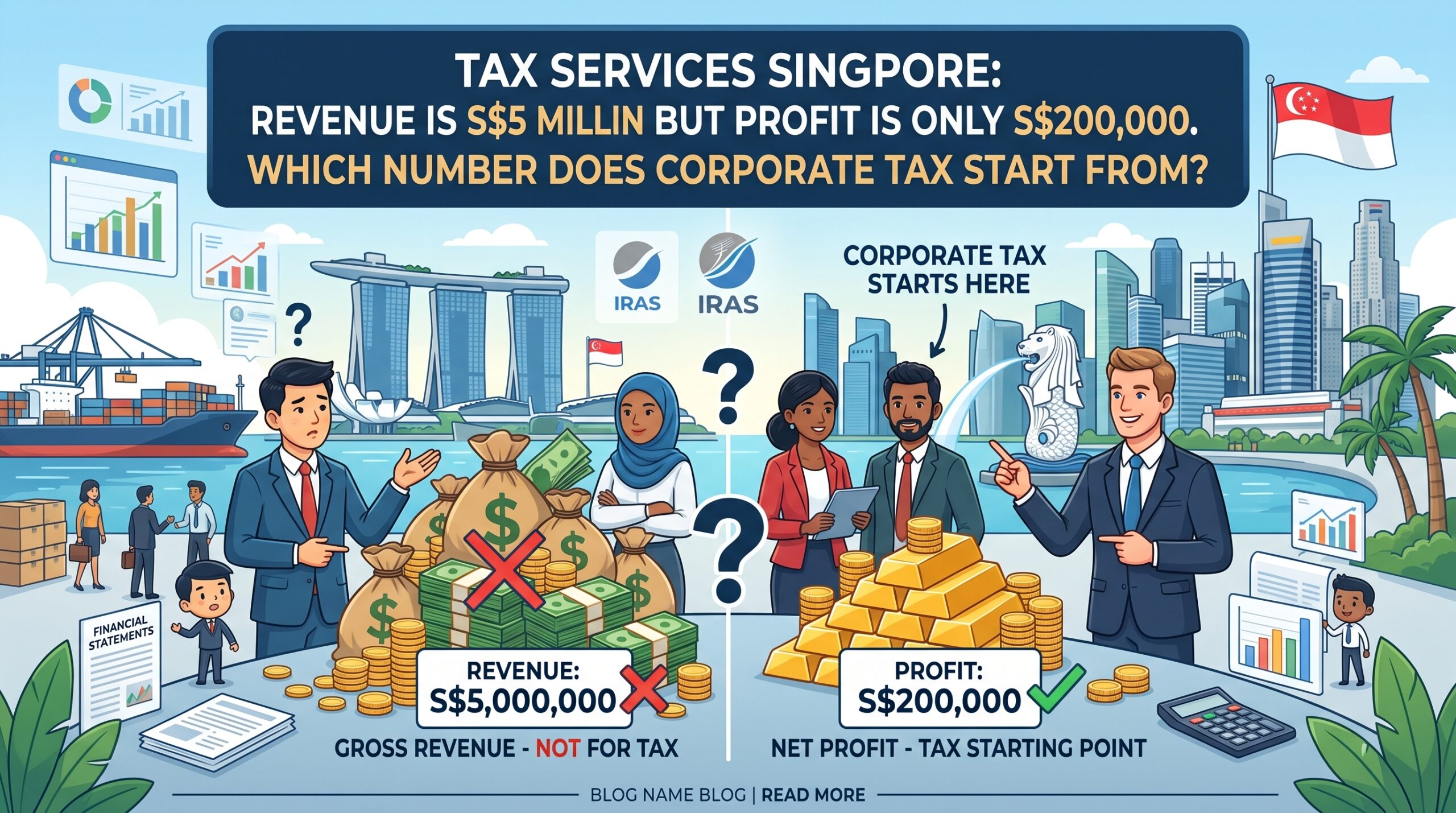
S$5 Million of Revenue Does Not Mean S$5 Million Is Being Taxed
Imagine a Singapore company that reports S$5 million in annual revenue. To someone looking only at the top line, the business appears substantial, and a director unfamiliar with corporate taxation might immediately wonder whether IRAS will apply Singapore’s corporate income tax rate to that S$5 million. Yet after salaries, rent, purchases, professional fees, utilities, logistics and other business costs are recorded, the company reports only S$200,000 in accounting profit. Which number matters for corporate income tax? The simple answer is that Singapore corporate income tax is not calculated by taking 17% of the company’s S$5 million revenue. However, it is also not necessarily as simple as taking 17% of the S$200,000 accounting profit. The tax computation generally starts from the company’s accounting results and then makes adjustments under Singapore tax rules to arrive at chargeable income. Understanding that journey is important because revenue, accounting profit and taxable or chargeable income represent different things, even though business owners sometimes use the terms interchangeably.
Revenue Tells You How Much the Business Earned Before Its Costs
Revenue is broadly the income generated from the company’s ordinary business activities before deducting the expenses incurred to operate the business. A company selling products might generate S$5 million from customers but spend S$3 million purchasing or manufacturing those products. It may then spend another S$1 million on employees, S$300,000 on rent and utilities, S$200,000 on logistics, marketing and technology, and another S$300,000 on other operating expenses. The remaining accounting profit could therefore be only S$200,000. Looking at revenue alone does not tell management how much economic benefit the company ultimately retained. Two businesses can each generate S$5 million of revenue while having completely different profitability because their cost structures are different. This is one reason corporate income tax is not simply a percentage applied to sales revenue. The expenses incurred in producing that income matter, although Singapore tax rules determine which expenses are deductible for tax purposes.
Accounting Profit Is Much Closer to the Starting Point
If the S$5 million company reports S$200,000 of profit before tax, that accounting profit is much closer to where the corporate income tax calculation begins. The accounts have already recognised revenue and deducted various costs according to the applicable accounting treatment. However, accounting standards and tax rules do not always treat an item in exactly the same way. An expense can be perfectly legitimate from an accounting perspective and still be non-deductible for tax purposes. Conversely, Singapore tax rules may provide deductions or allowances that are not represented by simply reading the accounting profit figure. This is why businesses using professional tax services Singapore should expect to see a tax computation rather than merely their accountant multiplying the profit before tax by 17%. The computation reconciles the accounting result to the amount that is ultimately subject to tax after applying the relevant tax rules.
Accounting Profit and Chargeable Income Answer Different Questions
Accounting profit attempts to show the financial performance of the company according to applicable accounting principles. Taxable or chargeable income is determined according to Singapore’s tax legislation and relevant tax rules. Those objectives are different, so the figures do not have to match. Imagine the company records S$200,000 of accounting profit, but S$30,000 of expenses included in the accounts are not deductible for tax purposes. Those expenses may need to be added back in the tax computation. The company may also be entitled to deductions, capital allowances or other tax adjustments that reduce the amount subject to tax. Consequently, S$200,000 of accounting profit could ultimately produce chargeable income above or below S$200,000 depending on the facts. Neither number is necessarily “wrong”. They simply measure the business from different perspectives.
Why Some Expenses Are Added Back in the Tax Computation
One of the most confusing parts of corporate tax for business owners is seeing expenses that have already reduced accounting profit being added back in the tax computation. The instinctive reaction is often, “But the company genuinely paid this money, so why are you adding it back?” The reason is that recording a cost in the accounts and obtaining a tax deduction are separate questions. Singapore tax rules generally require expenses to satisfy applicable deductibility conditions, including being incurred in the production of income, while specific rules may prohibit or restrict deductions for particular items. If an expense does not qualify for deduction, it can remain a valid accounting expense while being added back for tax purposes. This adjustment does not mean the accountant is reversing the actual payment or pretending the expense never happened. It simply prevents that expense from reducing taxable income where the tax rules do not permit the deduction.
Paying With the Company Bank Account Does Not Decide the Tax Treatment
Suppose the managing director uses the company bank account to pay S$8,000 for something primarily personal. The transaction undoubtedly occurred and needs to be properly accounted for, but the fact that company money was used does not automatically make the payment a tax-deductible business expense. This distinction is particularly important for owner-managed companies where personal and business decisions can become mixed. A company card, company cheque or company bank transfer identifies where the money came from. It does not determine whether the expenditure satisfies the relevant tax requirements. Businesses should therefore avoid thinking that every amount appearing in the expense section of the profit and loss statement will automatically reduce taxable income. Proper classification and documentation are essential when the tax computation is prepared.
Capital Expenditure Creates Another Important Difference
Another reason accounting profit and taxable income can differ is the treatment of capital expenditure. Suppose the company spends S$150,000 acquiring qualifying machinery that will be used for several years. From an accounting perspective, the asset may be capitalised and depreciated over its useful life rather than recognising the entire S$150,000 as an immediate expense. For tax purposes, accounting depreciation is generally not the mechanism used to obtain tax relief on qualifying plant and machinery. Instead, the company may be able to claim capital allowances according to the applicable rules. The tax computation may therefore add back accounting depreciation and separately deduct qualifying capital allowances. For a director looking only at the profit and loss statement, this can initially appear unnecessarily complicated, but it reflects the fact that accounting and tax systems have different rules for recognising the economic cost of long-term assets.
Depreciation Is a Classic Example of Why the Numbers Differ
Imagine the company records S$80,000 of depreciation in its financial statements. That S$80,000 reduces accounting profit, but it does not simply become an S$80,000 tax deduction because it appears as an expense. The tax computation generally adds back depreciation before considering the capital allowances available on qualifying assets. Depending on the assets acquired, timing and applicable rules, the capital allowance deduction may be higher or lower than the depreciation recorded in the accounts. The resulting taxable income can therefore move in a direction that surprises management. This is one reason estimating tax directly from the profit and loss statement can be unreliable. The accounting numbers provide the foundation, but the tax computation is required to translate those numbers into the appropriate tax treatment.
A S$5 Million Business Can Have a Surprisingly Small Margin
The example of S$5 million revenue and S$200,000 profit also highlights something important beyond taxation. The company’s accounting profit represents only 4% of revenue. That means relatively small changes in costs or pricing could materially affect profitability. If operating costs increase by S$100,000 without a corresponding increase in revenue, profit could fall from S$200,000 to S$100,000. Conversely, a modest improvement in gross margin or operational efficiency could significantly increase profit. When management focuses only on the S$5 million sales figure, it can overlook how little of every revenue dollar remains after costs. Tax planning should therefore sit within a wider understanding of profitability rather than being viewed as an isolated annual compliance exercise.
The 17% Corporate Tax Rate Is Not 17% of Revenue
Singapore’s prevailing corporate income tax rate is 17% of chargeable income, not 17% of a company’s turnover. If someone incorrectly applied 17% directly to S$5 million of revenue, they would arrive at S$850,000 of tax, which would exceed the S$200,000 accounting profit in our example by a huge margin. That calculation clearly illustrates why revenue is the wrong starting point for estimating corporate income tax. Even applying 17% directly to the S$200,000 accounting profit to obtain S$34,000 should be treated only as a rough illustration rather than the final tax calculation, because tax adjustments, exemptions, rebates and other applicable provisions may change the actual amount payable. Businesses need to work from the tax computation rather than simply applying the headline rate to whichever number appears most obvious in the financial statements.
Tax Exemptions Can Further Change the Final Amount
Singapore also has corporate tax exemption schemes that can affect the effective amount of tax paid. Qualifying newly incorporated companies may potentially benefit from the Start-Up Tax Exemption scheme during the relevant first three Years of Assessment, while other qualifying companies may benefit from the Partial Tax Exemption scheme. These mechanisms mean that even after the company determines its chargeable income, simply multiplying the entire amount by 17% may still not reflect the final tax payable. Eligibility and calculations depend on the company’s circumstances and the applicable Year of Assessment. This is another reason comparisons such as “my friend’s company made the same profit but paid less tax” can be misleading. Two businesses with apparently similar accounting profits can have different taxable positions because of their expenses, allowances, losses, exemptions, rebates and other circumstances.
YA 2026 Adds Another Layer Through the Corporate Income Tax Rebate
For Year of Assessment 2026, Singapore has enhanced the Corporate Income Tax Rebate to 50% of corporate tax payable, subject to the overall applicable cap. Qualifying active companies can also receive a S$2,000 CIT Rebate Cash Grant, with the total maximum benefit capped at S$40,000. This demonstrates why directors should distinguish between the corporate income tax rate and the amount ultimately payable. The 17% rate remains relevant, but rebates can reduce the final liability after the underlying tax computation has been prepared. A company should therefore avoid assuming that the headline tax rate alone tells the complete story. At the same time, a temporary rebate should not be confused with a permanent reduction in the corporate tax rate, and management should avoid building long-term financial plans around support that applies only to a particular Year of Assessment.
Losses Can Change the Story Completely
Now imagine the same company generates S$5 million of revenue but incurs S$5.2 million of expenses, resulting in an accounting loss of S$200,000. The company has substantial sales, but that does not mean it automatically has a corporate income tax bill based on the S$5 million turnover. The tax computation would still need to determine the company’s tax position after applying the relevant rules. Subject to conditions, qualifying unutilised trade losses may potentially be carried forward and used against future taxable profits, while other mechanisms may also be available in appropriate circumstances. The important point is that high revenue does not necessarily mean high taxable income. Revenue tells you the scale of sales activity, while profitability and tax adjustments determine a very different part of the financial story.
Past Losses May Matter When the Business Returns to Profit
Suppose the company lost money during earlier years but finally earns S$200,000 of accounting profit this year. Management might assume that tax will immediately be calculated on the full current-year amount. However, qualifying unutilised losses brought forward from previous Years of Assessment may potentially be available for deduction against future income, subject to the relevant conditions. This can materially affect the current tax position. It also illustrates why tax records need continuity from year to year. A new accountant cannot always understand the company’s current tax position merely by reading this year’s profit and loss statement. Historical tax computations, assessments and schedules may contain information about unutilised losses, allowances or other items that remain relevant.
Revenue Thresholds Still Matter for Other Tax and Compliance Questions
Although corporate income tax is not calculated directly on revenue, revenue remains important in Singapore’s tax and regulatory environment. Different thresholds may determine filing obligations, eligibility for simplified forms, GST requirements or other compliance matters. For corporate income tax filing, for example, IRAS provides different return forms depending on whether companies meet the applicable conditions, including revenue thresholds. This is why a S$5 million revenue figure should not be dismissed simply because corporate tax is not charged directly on it. Turnover can influence which compliance requirements apply even when the actual tax liability depends on chargeable income. Good tax services Singapore therefore involve understanding both the company’s profitability and the wider significance of its revenue level.
ECI Introduces the Tax Question Soon After Financial Year-End
Businesses also need to understand Estimated Chargeable Income, commonly called ECI. IRAS describes ECI as an estimate of a company’s taxable profits after deducting tax-allowable expenses, and companies generally need to consider the ECI filing requirement within three months after the end of their financial year unless they qualify for the administrative concession not to file. This means management may need to think about the company’s tax position before every accounting adjustment has been finalised. If revenue is S$5 million but preliminary accounting profit is around S$200,000, finance should not simply report S$5 million as ECI. The company needs an estimate of its taxable profit, which again reinforces the difference between sales, accounting profit and the amount relevant for corporate taxation.
Tax Planning Should Begin Before the Filing Deadline
A common mistake is treating corporate tax as something that begins when the annual tax return is due. By that point, the financial year has already ended and many business decisions cannot be changed retrospectively. Effective tax management starts earlier by maintaining proper records, understanding significant transactions and identifying potentially relevant tax treatments while information is still readily available. If the company purchases major equipment, enters a new business activity, incurs substantial professional fees or begins operating overseas, finance should consider the tax implications at the time rather than waiting until filing season. Professional tax services Singapore can be particularly useful when management wants to understand the implications of decisions before they are finalised, rather than merely documenting what happened months later.
Supporting Documents Matter Because Tax Treatment Needs Evidence
Suppose the S$5 million company has S$4.8 million of expenses recorded in its accounts, leaving S$200,000 of accounting profit. Management may believe the tax calculation is straightforward because all expenses are visible in the accounting system. However, proper records and supporting documents remain important. IRAS requires companies to keep proper records and accounts, including source documents and accounting records, generally for at least five years from the relevant Year of Assessment. A ledger entry showing “consultancy S$50,000” tells only part of the story. The company should be able to support the transaction and its business purpose through appropriate documentation. Good bookkeeping therefore directly supports tax compliance because the quality of the tax computation depends on the quality of the underlying financial records.
A Bank Payment Proves Money Moved, Not Necessarily Why
This distinction becomes particularly important when businesses rely heavily on bank statements. A bank record can demonstrate that S$20,000 left the company’s account and went to a particular recipient, but it may not fully establish what was purchased, why the expenditure was incurred or how it should be treated for tax purposes. Supporting invoices, agreements and other relevant documentation provide context. Years later, an employee may no longer remember why a payment was made, and the supplier description in the bank statement may be insufficient to reconstruct the transaction. Businesses should therefore maintain documentation throughout the year instead of trying to rebuild their records only when preparing the tax return.
Good Bookkeeping Makes the Tax Computation Easier to Understand
The relationship between bookkeeping and taxation becomes obvious when the year-end tax computation is prepared. If expenses are consistently classified, supporting documents are organised, fixed assets are properly recorded and unusual transactions are identified throughout the year, the tax process becomes much more manageable. If everything has been posted into broad categories such as “general expenses”, however, the accountant may need to examine hundreds of transactions before determining their tax treatment. Poor bookkeeping does not necessarily mean the company owes more tax, but it can make compliance slower, increase the risk of errors and make it harder to support legitimate deductions. For Yisong Accounting Management, this is where bookkeeping and tax services Singapore naturally work together rather than functioning as completely separate annual exercises.
Do Not Manage the Business Just to Reduce Tax
Another mistake is making poor commercial decisions simply because an expense may reduce taxable income. Suppose management considers spending S$100,000 on something the business does not genuinely need because someone says, “At least we can claim it for tax.” Even if the expenditure qualifies for a full deduction, a deduction does not mean IRAS reimburses the entire S$100,000. The company still spends real money to obtain the deduction. Tax considerations should therefore support good business decisions rather than replace them. If equipment, technology, training or professional services genuinely improve the company, the availability of tax deductions or incentives may make the investment more attractive. Spending money purely to reduce taxable profit, however, can leave the company financially worse off.
A Higher Tax Bill Can Sometimes Be a Sign of a Healthier Business
Business owners naturally prefer paying less tax, but an increasing corporate income tax bill is not always bad news. If the company’s taxable profits rise because revenue and margins improved substantially, paying more tax may simply reflect stronger financial performance. The objective of tax planning should not be to eliminate tax at any cost. It should be to ensure that the company claims legitimate deductions, exemptions, allowances and incentives while complying with the applicable rules. A company that destroys S$100,000 of profit merely to save a fraction of that amount in tax has not created value. Good tax planning works alongside profitability, cash flow and long-term business strategy.
Compare Effective Tax Outcomes Carefully
Directors often compare their company’s tax bill with another business and wonder why the figures differ. Suppose both companies report S$200,000 of accounting profit, but one pays materially less corporate income tax. That does not automatically mean one accountant discovered a secret tax strategy. The companies may have different capital allowances, brought-forward losses, non-deductible expenses, exemption eligibility, foreign income, tax credits or other adjustments. Even the timing of transactions can matter. Meaningful tax comparisons require understanding the tax computation rather than comparing a single profit number. The same applies when someone claims that their company “only pays 5% tax” despite Singapore’s 17% headline corporate income tax rate. The effective outcome may reflect circumstances that do not apply to another business.
Management Should Understand the Bridge From Profit to Tax
Directors do not need to become tax specialists, but they should understand the basic bridge between accounting profit and chargeable income. If the accounts show S$200,000 profit and the tax computation produces a substantially different figure, management should be able to ask why. The explanation might involve depreciation being added back, capital allowances being deducted, non-deductible expenses, prior-year losses or other adjustments. Understanding these major movements makes tax less mysterious and allows directors to identify unexpected results. A tax computation should not be treated as a document that only the accountant understands. It is part of the company’s financial information and can provide useful insight into how business decisions translate into tax outcomes.
Yisong Can Help Connect the Accounts to the Tax Position
For businesses using Yisong Accounting Management, professional accounting and tax services Singapore can help connect day-to-day financial records with the company’s eventual corporate tax obligations. The process begins with organised bookkeeping and reliable financial information, followed by identifying relevant tax adjustments, preparing the tax computation and completing the appropriate filings. This connection is especially important for growing companies because increasing transaction volumes, additional employees, new assets and more complex business arrangements can create tax questions that were not significant when the company was smaller. Rather than waiting until the filing deadline to discover these issues, businesses benefit from maintaining financial records that allow their tax position to be understood throughout the year.
Conclusion: Start With the Business Profit, Then Apply the Tax Rules
A Singapore company generating S$5 million of revenue and S$200,000 of accounting profit does not normally calculate corporate income tax by applying 17% to the S$5 million revenue figure. Revenue shows the scale of the company’s sales activity, while accounting profit reflects what remains after recognised expenses. The tax computation then takes the accounting results and applies Singapore tax rules to determine the amount that is ultimately chargeable to tax. Expenses that are not deductible may be added back, accounting depreciation may be replaced by qualifying capital allowances, brought-forward losses may affect the result, and applicable exemption schemes or rebates may further change the final amount payable. This is why the company can legitimately have S$5 million of revenue, S$200,000 of accounting profit and yet another figure representing its chargeable income.
Understanding these distinctions helps business owners avoid two opposite mistakes. The first is becoming unnecessarily alarmed by a large revenue figure and assuming a large percentage of sales must be paid to IRAS. The second is assuming that the profit shown in the financial statements can simply be multiplied by 17% to produce the final tax bill. Both approaches overlook how corporate tax actually interacts with accounting information. Revenue, accounting profit, taxable income and final tax payable are connected, but they are not interchangeable numbers, and each tells management something different about the business.
For growing businesses, the better approach is to maintain reliable accounts throughout the year and understand significant tax adjustments before filing deadlines arrive. Good records make it easier to support legitimate deductions, identify relevant allowances, prepare ECI where required and explain why the final tax position differs from the accounting result. Professional tax services Singapore can then focus on applying the relevant rules to reliable financial information instead of spending unnecessary time reconstructing transactions or correcting poorly maintained records.
The most useful way for management to think about the example is therefore straightforward: S$5 million tells you how much business came through the door, S$200,000 tells you what the accounts say was left as profit, and the tax computation determines how much of the relevant income is ultimately subject to corporate income tax after applying Singapore’s tax rules. Once business owners understand those three stages, the corporate tax calculation becomes far easier to follow, and conversations with their accountant can move beyond simply asking why 17% was not applied to the number they expected.